Beneath this week's market jitters, a subtle but meaningful shift is taking place.
It was another week where headlines, above all, drove the stock market. We had stories about AI disrupting software jobs, rising geopolitical tensions, and whispers of credit problems in the private credit space. Put all that together, and it’s no surprise investors felt a little uneasy or indecisive.
At some point in the week, it looked like money might rotate back into tech stocks, with many investors hoping NVIDIA’s earnings beat would put those stocks back in favor. Alas, that didn’t happen. The week, and with it the month, ended on a note more cautious than confident.
Let’s look at where the major indexes finished out this February.
S&P 500 ($SPX): 6878.88 (-0.87%)
Nasdaq Composite ($COMPQ): 22,668.21 (-3.38%)
Dow Jones Industrial Average ($INDU): 48,977.92 (+0.17%)
The tech-heavy Nasdaq was the weakest performer for the month. The Dow, which is made up of established, dividend-paying stocks, was the strongest.
What this suggests is that investors may be rotating away from large-cap growth stocks, especially in the technology space, and toward more defensive areas of the market. In addition, we're seeing interest in precious metals, another sign that investors are seeking safety.
This is a shift that investors shouldn’t ignore.
Why This Matters for Investors
Risk management is an important component in investing, yet individual investors don’t pay enough attention to it. Active money managers, on the other hand, understand risk management. Their positioning reveals an interesting point.
The NAIIM Exposure Index, which tracks how actively managed portfolios are allocated to equities, is at 74.93 this week. What’s more important in the chart below is that equity exposure has been steadily declining this year.
You can track this yourself on StockCharts.
💡
Try This. Type !NAAIM in the Symbol Box and select the Histogram Chart Type.
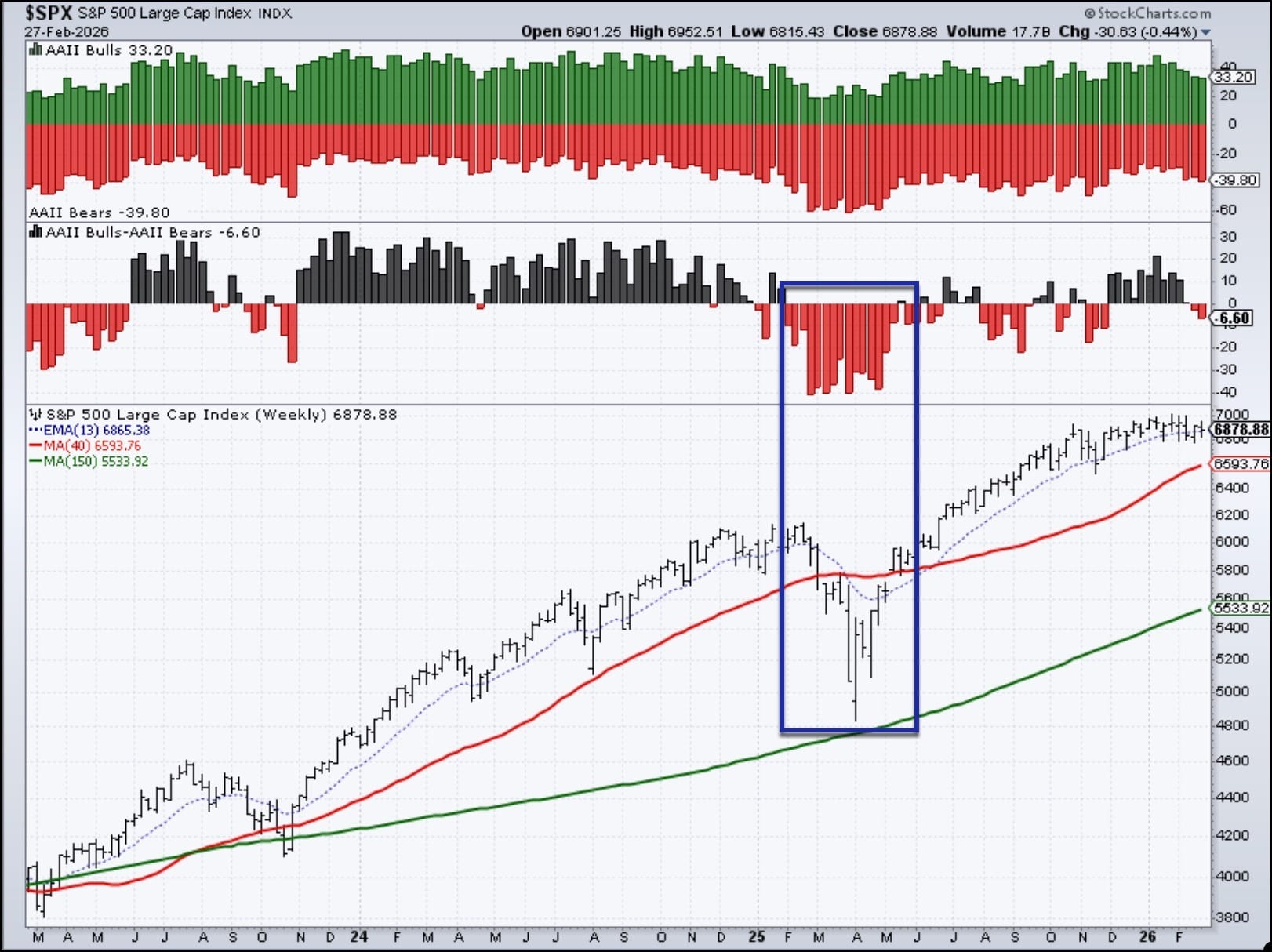
Now look at what individual investors are doing. The AAII Bulls - Bears sentiment indicator shows that investors are 33.2% bullish and 39.8% bearish. This shows that bearishness is beginning to edge out bullishness.
Earlier last year (January and May 2025), investors were much more bearish than bullish. During that stretch, the S&P 500 dipped below its 40-week Simple Moving Average hitting a low in April. That was around the time when tariffs were implemented.
💡
Want to explore the data yourself? Just click the chart to open a live version on StockCharts. Feel free to modify the time frame and chart settings.
So, looking at sentiment, we’re not seeing a major red flag, but we are seeing early caution signals. As we head into March, stay even more alert to these sentiment indicators, as they could give an early indication.
When strong earnings stop driving higher prices, leadership may be shifting. Learn the chart signals that tell you when an AI stock is rolling over. ...
The Utilities sector is approaching a seasonally strong month. Tom Bowley analyzes this sector and makes a case for why utility stocks may soar in March. ...
The Mag 7 stocks have lost steam since November. However, four of the seven are showing long-term uptrends. Arthur Hill analyzes each of these charts and identifies potential reversal or continuation levels. ...
The 10-Year Treasury yield is close to a key support level, the S&P 500 is showing signs of weakening momentum, and the US dollar could see some upside movement. Add these charts to your StockCharts ChartLists as we enter a volatile period. ...
There has been a shift in market leadership, suggesting that we may be in the later stages of a business cycle. Martin Pring's analysis of these rotations uncovers the scenarios we can expect during this stage. ...
JPM's stock price is showing technical weakness. Here's a bearish options strategy setup with a compelling risk/reward structure. Explore how you can take advantage of it. ...
As a StockCharts Member, you unlock all of our most powerful tools and features, including saved charts and settings, custom scans, technical alerts and much more. Discover all that StockCharts can do with our
free 1-month trial and start charting like a true market pro.
The "Symbol Summary" panel within StockChartsACP adds a powerful research tool to your charts, including a full quote summary for stocks, ETFs, mutual funds and indexes with technical stats, fundamentals, earnings, after-hours data, dividends, corporate info and more.